Learning how to design a wedding dancefloor starts with your colour palette and your venue, not the floor itself. Pull your monogram, your colours or a pattern from your invitations and stationery, then decide between a printed design and an LED floor based on your venue's lighting and your evening plans. Get this order right and the floor looks like part of the wedding, not an add-on bolted onto the room.
A dancefloor sits under every photo of your first dance and every group shot of your guests letting loose. It is one of the few design elements guests actually stand on, so it is worth more thought than most couples give it. This guide walks through the real decisions, from custom printed dancefloor ideas to the LED versus print question, so you can brief a supplier properly instead of picking from a catalogue at random.
Start With Your Theme, Not the Floor
Before choosing a design, go back to the details you have already settled. Your colour scheme, your stationery, your florals, even your venue's existing flooring all give you a starting point. A floor that repeats a motif from your invitations, such as a monogram or a border pattern, ties the room together without needing extra decor.
Think about the mood too. A romantic garden wedding calls for something soft, maybe a floral or a marble effect. A Bollywood sangeet or a high energy reception usually works better with bold colour and a strong central design that reads well from a raised stage or a balcony.
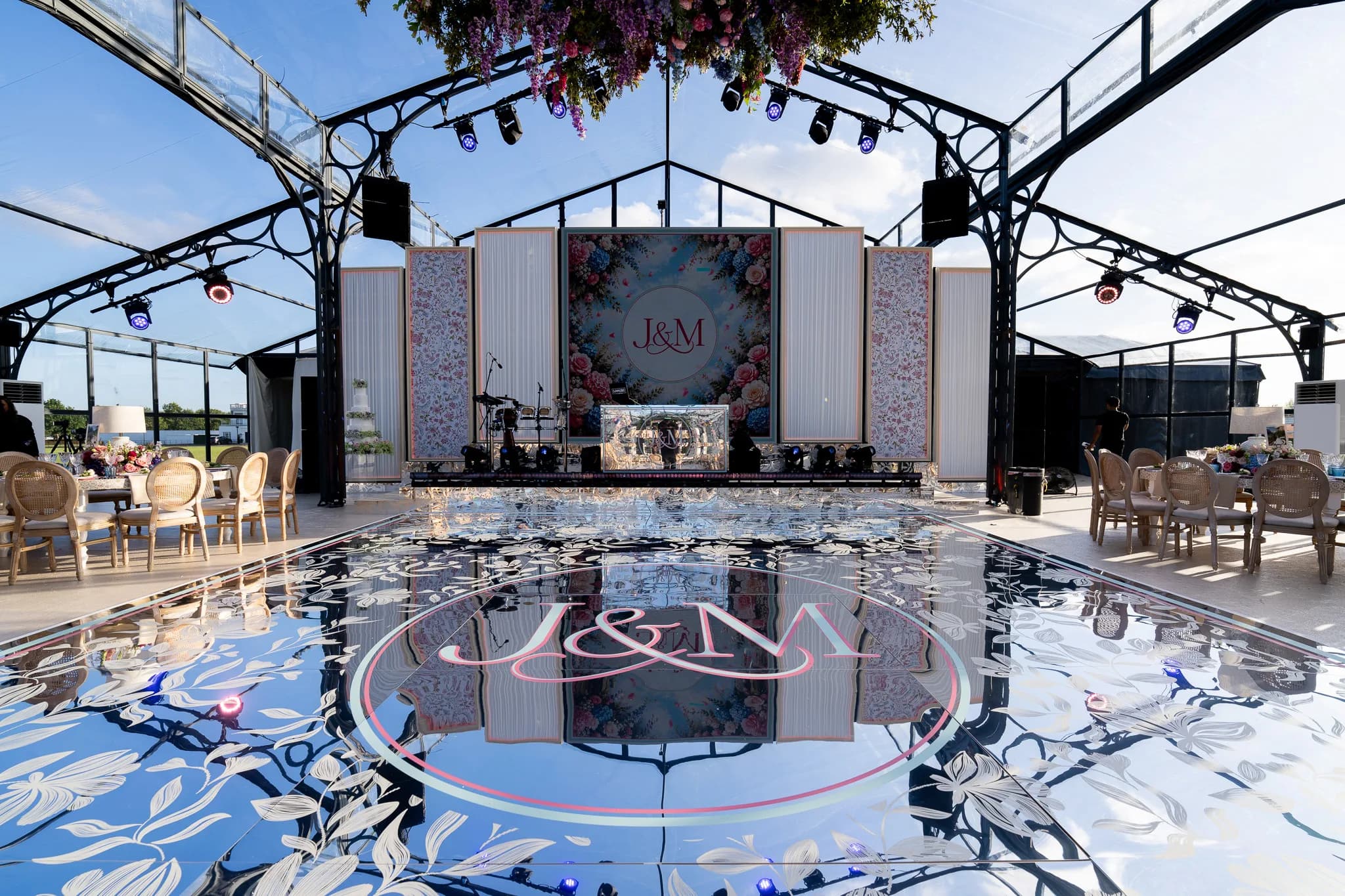
Look at your venue's existing floor and walls as well. A busy carpet or a patterned tile underneath needs a simpler dancefloor design on top, or the two will fight each other in photos. In a glass marquee or a fabric-roofed tent the opposite is true: the ceiling gives nothing back, so a reflective floor is the one surface that will. That is why we printed the floor at a glass marquee wedding at Dallas Burston Polo Club as a mirror, with the couple's initials in a ring at the centre and a trailing foliage pattern that matched the florals overhead.
Custom Printed Dancefloor Ideas
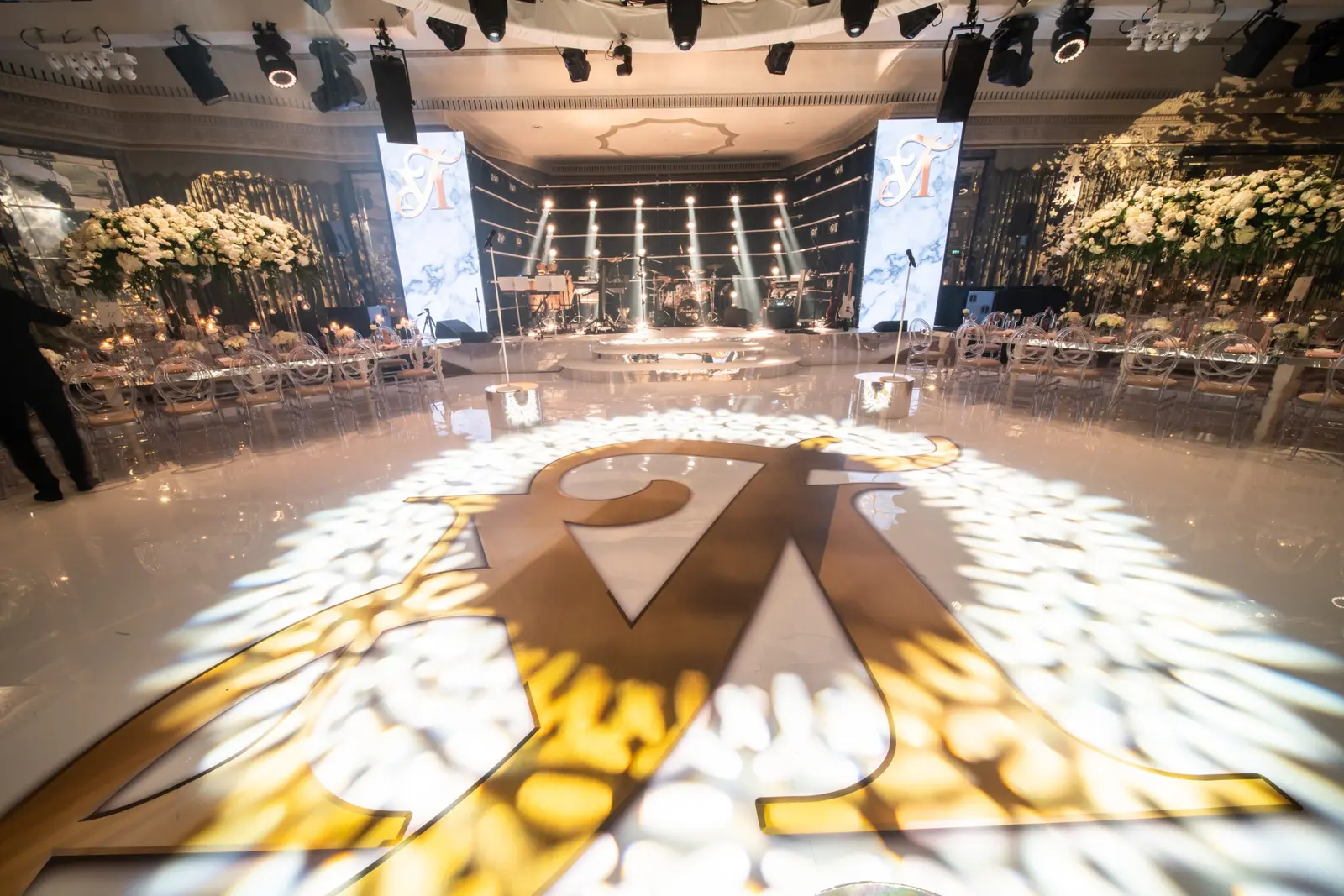
A printed dancefloor is a vinyl covering laid over a standard dancefloor base, printed with your chosen design. It is the most flexible option because almost anything can be printed, from a full colour scene to a simple monogram on a plain background.
Popular custom printed dancefloor ideas include:
- A couple's initials or monogram in the centre, on white, black or a mirror finish
- A marble or geometric pattern that matches the table linen
- A floral design that continues from the ceremony flowers
- A full scene, such as a skyline or a pattern tied to a destination wedding location
- Something more personal, like a family crest or a motif used across the whole day
If you are comparing quotes, it helps to know that a dance floor wrap wedding design can be matched to the same artwork used on your backdrops and signage, so the print carries across the room rather than sitting on its own. We print the floor, the bar wrap, the backdrop and the seating plan in our own print room, off the same calibrated kit, and check them side by side before they leave the building. One gold, not four suppliers' idea of gold.
The main advantage of print is how well it photographs. A printed design holds still and looks the same in every shot, whether it is lit by fairy lights or full room lighting. It also tends to cost less than a full LED floor, which matters if your budget is going elsewhere.
LED Dancefloor vs Printed Dancefloor
This is the question most couples get stuck on, and the honest answer depends on your event, not on which one looks more impressive in a supplier's portfolio photo.
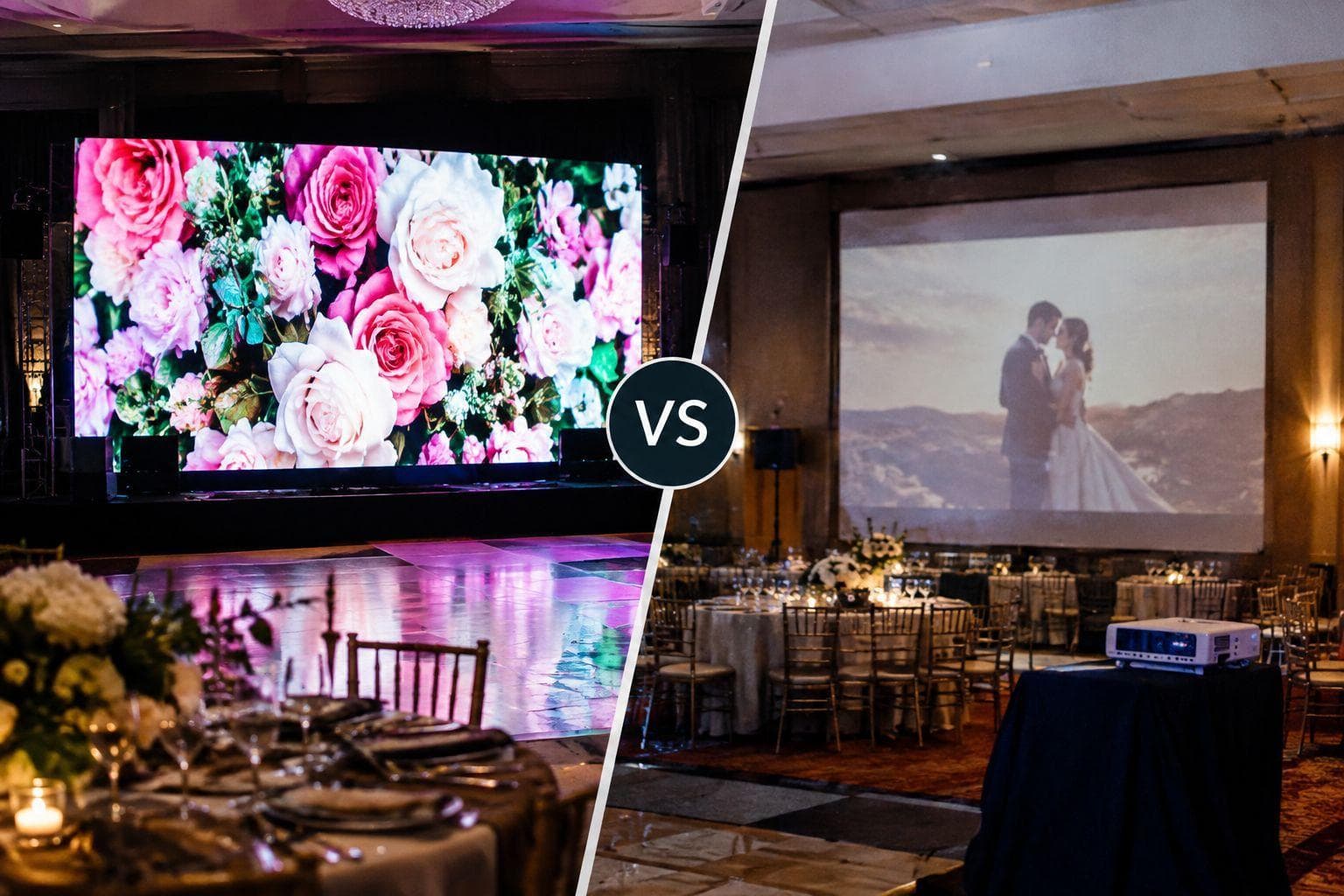
An LED dancefloor lights up from underneath, often reacting to the music or changing colour through the night. It suits evening receptions with low ambient lighting, where the floor becomes part of the show rather than just a surface. It works particularly well for a high energy party segment, since the colour and movement add to the atmosphere once the room is dark.
A printed dancefloor stays fixed and does not rely on darkness to look good. It works in any lighting, including daytime marquee weddings or venues that cannot fully dim the room. It also gives sharper detail for a monogram, text or an intricate pattern, since LED panels are built from a grid of pixels and lose the fine detail that print can hold.
| Factor | LED dancefloor | Printed dancefloor |
|---|---|---|
| Best lighting | A dark room, evening only | Any lighting, daytime included |
| Fine detail (monograms, text) | Limited by the pixel grid | Sharp at any size |
| Changes through the night | Yes, colour and movement | No, one fixed design |
| Photographs | Depends on the moment | The same in every shot |
| Typical cost | Higher | Lower |
| Best for | The party segment in a dark room | A design that ties into the whole day |
Some couples choose both, with a printed floor during the meal and the speeches, then a switch to LED once the dancing starts. This needs more planning and a supplier who can manage the changeover without slowing the evening down, so ask early whether your venue and your supplier can support it.
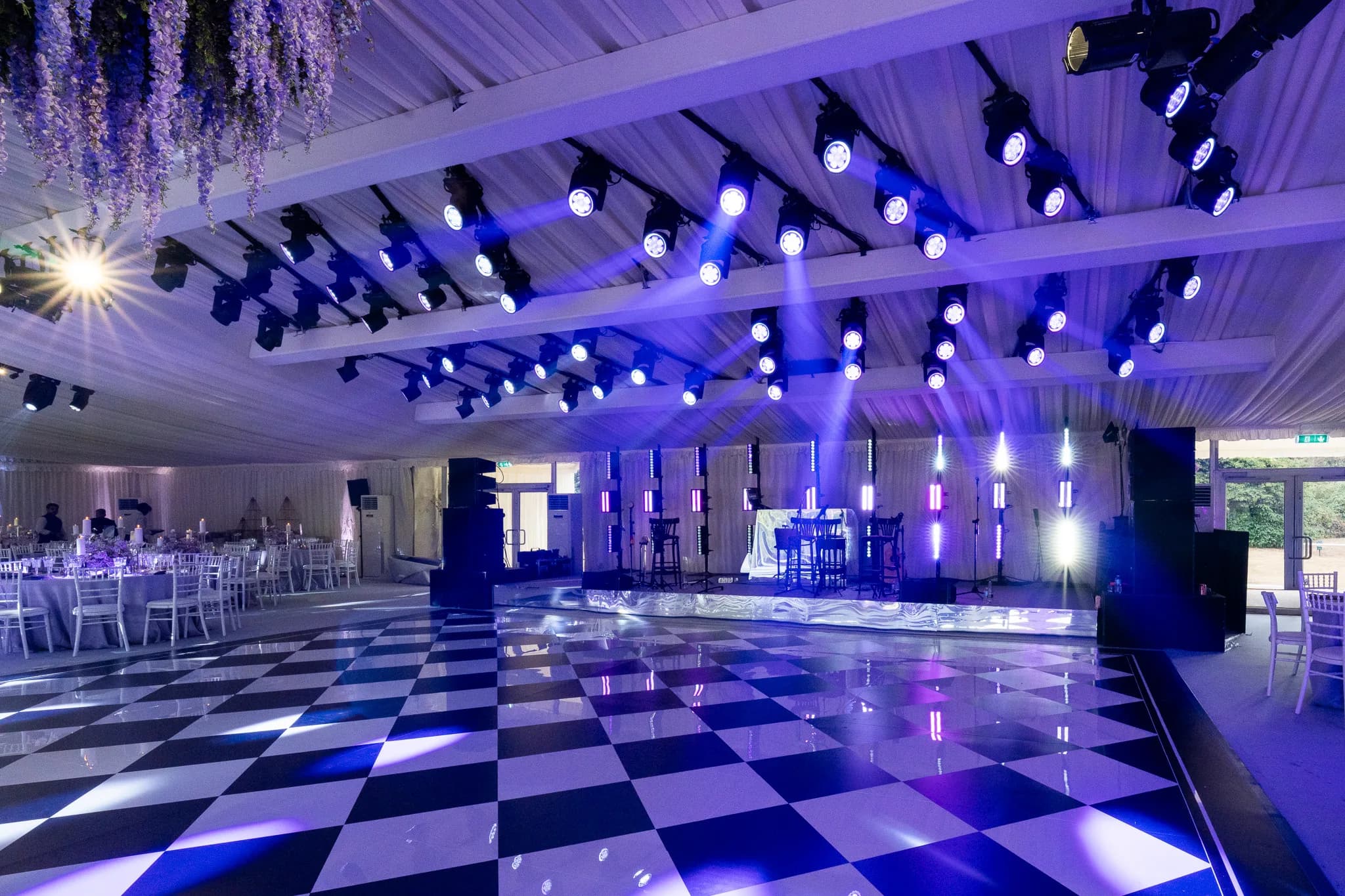
Our own view, for what it is worth: in a marquee we would rather print a mirror floor than light one. At a 500 guest marquee reception at Pennyhill Park we printed the floor as a chequerboard mirror and every beam, every colour change and the florals hanging above landed on it a second time. The room looked like it had twice the rig in it. It did not.
How to Match Your Dancefloor to Your Wedding Theme
If you are still working out how to match dancefloor to wedding theme choices, a few practical steps make the final decision easier.
- Take a fabric swatch or a colour code from your stationery and share it directly with your supplier, rather than describing the colour from memory.
- Ask to see a proof or a rendered mockup before printing, since colours can shift once they are printed at large scale.
- Check the floor size against your actual guest count and venue layout. A floor that is too small gets crowded fast once the party starts, and one that is too large can look empty during the quieter moments.
- Confirm that delivery, setup and collection are handled by the same team producing the design.
That last one matters more than it sounds. A supplier who only prints the vinyl and leaves the base and the installation to someone else adds a layer of coordination you do not need on your wedding day. With us the crew fitting the floor is the crew building the stage and DJ booth it meets, so the floor, the booth and the backdrop are designed as one look and arrive with the same crew.
Wedding Dancefloor Design Trends 2026
Current wedding dancefloor design trends lean towards bold, graphic designs over the softer watercolour looks that were common a few years ago. Strong geometric borders, oversized monograms and two tone colour blocking are showing up often in current wedding coverage. For LED floors, colour changing panels that shift with the music, rather than a fixed single colour, are becoming the more requested option.
Dancefloor Decal for Wedding: What to Know
A dancefloor decal is the printed vinyl sticker itself, applied over a rigid dancefloor base. It is usually made in sections and pieced together on site, so ask your supplier how the joins are handled and whether they will be visible in photos.
A good decal should be slip resistant, since a beautiful floor is no use if it is not safe to dance on in heels or dress shoes. Ours are laminated for grip and laid level, so they are safe in heels.
The Takeaway
Your dancefloor should feel like it belongs to your wedding, not a rented extra. Start with your existing colours and theme, decide between print and LED based on your venue and your evening plan, and always ask to see a proof before anything is printed.
At Kudos Music, dancefloor design is produced in our own print room alongside backdrops, bar wraps and signage, so the whole look is designed and built by one team. Our stage and set workshop also builds the DJ booth and the staging around it, so the floor is not the only thing tying into your theme. If you want to talk through options for your date, check availability with Kudos Music.
FAQ
1. How much does a custom wedding dancefloor cost?
Ans. Cost depends on size, whether it is printed or LED, and how complex the design is, so most suppliers quote after seeing your guest numbers and venue.
2. How far in advance should I order a printed dancefloor?
Ans. Aim to confirm your design a few months ahead, since print production and proofing take time, especially in peak wedding season. Because we own the printer, we will give you the real cut-off for your date rather than a cautious one.
3. Can a dancefloor be used outdoors?
Ans. Some printed and LED floors can be used outdoors on a hard, level surface, but always confirm weather protection and suitability with your supplier first.
4. Does an LED dancefloor need a DJ to control it?
Ans. Many LED floors are controlled separately from the DJ booth, though some suppliers sync the lighting effects with the music for a more connected feel.
5. Is a printed dancefloor slippery?
Ans. A well made dancefloor decal is finished with a slip resistant coating, so it should be safe for normal dancing and shoes.