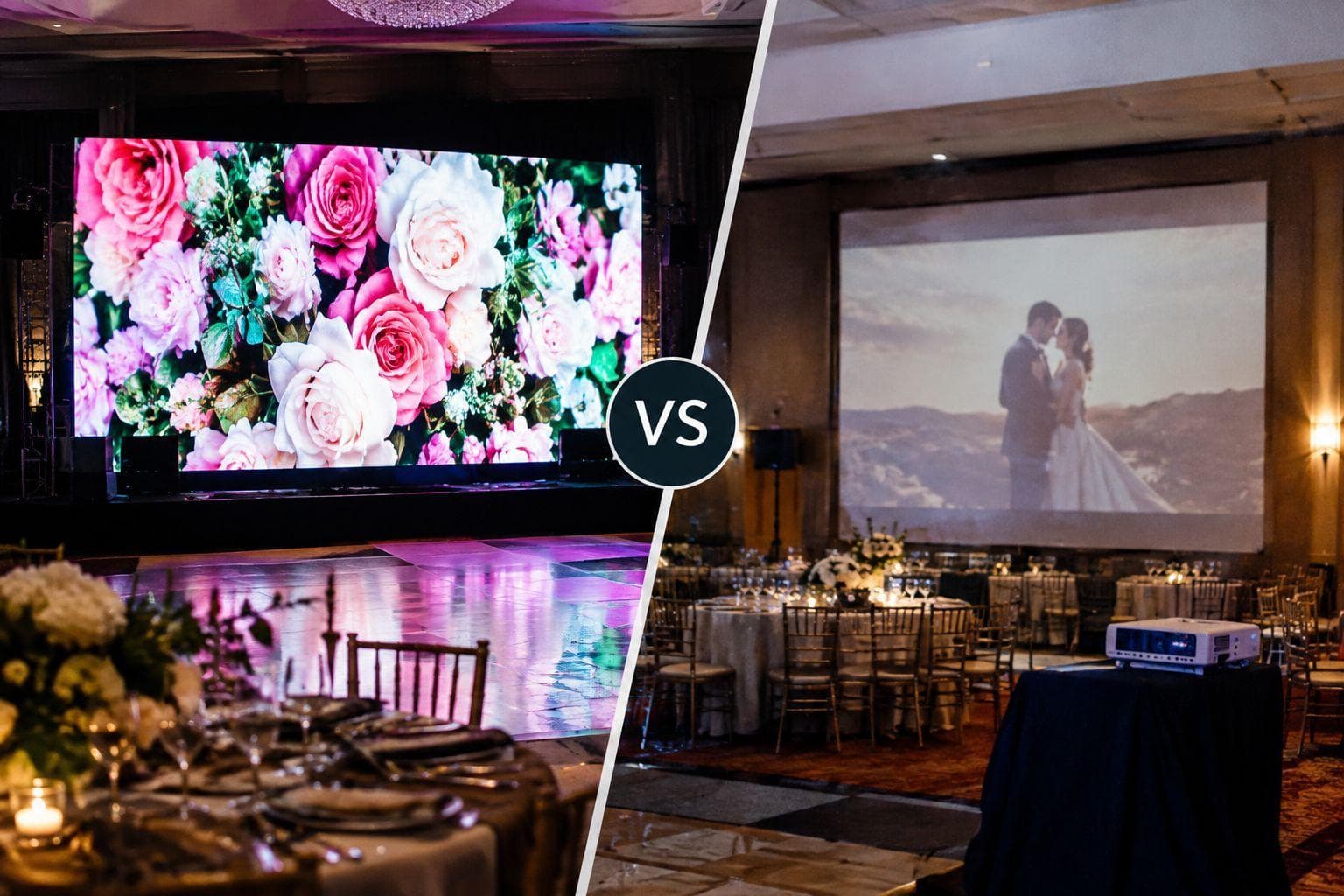
LED screens vs projection for weddings comes down to one question. Will your speeches, first dance and reception visuals be seen clearly by every guest, or only the ones near the front? LED screens give a brighter, sharper image that holds up in daylight and full room lighting. Projectors cost less and can throw a much bigger image, but they need a dark room and a clean line of sight to work well. The right choice depends on your venue, your guest count and what you actually want the screen to do.
Here's what actually matters for your venue and your budget, not what looked good in someone else's wedding video.
What Is the Real Difference Between LED Wall and Projectors?
An LED screen is made of small screen panels joined together to form one large, self-lit display. A projector throws light from a lamp onto a separate screen or surface. That single difference explains almost every trade-off between them.
Because an LED screen generates its own light, it stays sharp and clear even with the room lights on, string lights glowing and guests holding phones up. A projected image relies on contrast between the light source and the room around it. Turn the lights up, or let afternoon sun through a marquee wall, and the picture starts to wash out. This is the main reason couples researching LED wall vs projector for events end up choosing LED once they've seen both in a similar space.
Do I Need an LED Screen for My Wedding?
Not every wedding needs one. If your reception is informal, your guest list is under 80 and you mainly want a slideshow running quietly during dinner, a projection screen for wedding reception use is often enough and considerably cheaper.
An LED screen earns its cost when any of the following apply:
- You're live streaming speeches or the first dance to screens so back tables can see faces, not just hear a microphone
- The room has chandeliers, windows or can't be blacked out
- You want a lit, cinematic entrance or stage backdrop, not just a slideshow between courses
- Your guest count is large enough that sightlines to a flat projector screen become a problem
- The visuals are part of the design, not an afterthought, and need to look intentional in every photo
If none of those match your day, save the budget for elsewhere and go with projection.
LED Wall vs Projector for Events: Cost and Practicality
Projectors are the cheaper starting point. A single unit and screen can be hired for far less than an LED screen of a similar size, and setup is quicker in a venue that's used to hosting events with a stage and screen already in place.
LED walls cost more because of what's involved. The panels, the rigging frame, the processor that drives the image and the crew needed to build and calibrate it all add to the day rate. That cost buys you a screen that looks the same whether the lights are up or down, and one that can be shaped to fit an awkward stage or an outdoor structure rather than needing a flat wall to project onto.
| Factor | LED Screen | Projector |
|---|---|---|
| Works in daylight or full room light | Yes | No, needs low light |
| Typical cost | Higher | Lower |
| Setup time and crew needed | More | Less |
| Image brightness and colour | Strong, self-lit | Depends on ambient light |
| Flexible shapes and sizes | Yes, panels join together | Limited to a flat screen |
| Best for | Large or bright rooms, live feeds, staged backdrops | Smaller, dimmable rooms, simple slideshows |
Best Visuals for Indoor vs Outdoor Weddings
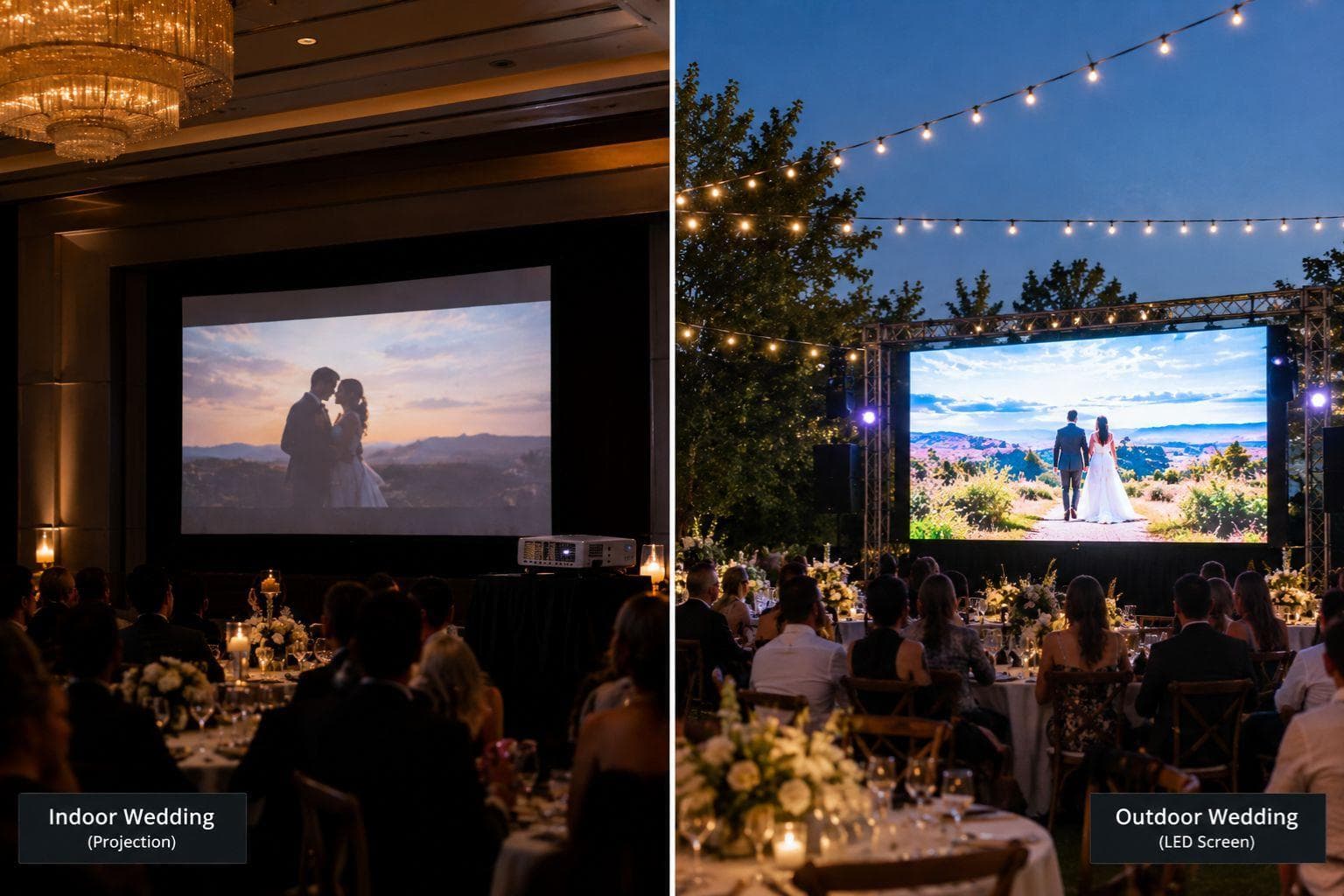
Indoor venues with dimmable lighting and full blackout curtains are where projection performs closest to its best. A hotel ballroom that can go dark for the first dance video is a fair fight between the two options.
Outdoor and marquee weddings are a different story. Daylight, fairy lights and open sides make it hard for a projected image to hold contrast, especially before sunset. An LED screen keeps its brightness regardless of what's happening around it, which is why it tends to be the safer choice for garden weddings, marquees and any reception that starts before dark.
If your day moves between spaces, a bright outdoor ceremony followed by an indoor reception, it's worth planning the visuals for each moment separately rather than assuming one setup will suit both.
Pros and Cons of LED Walls at Weddings
Pros
- Stays clear and bright regardless of ambient light
- Can be built into different shapes for a stage backdrop, not just a flat screen
- Holds up better in photos and video than a projected image
- Works reliably outdoors and in marquees
Cons
- Higher cost than projection, particularly for larger walls
- Needs more rigging time and a dedicated crew
- Heavier and requires proper structural support, especially outdoors
An LED wall rarely stands on its own, most couples pair it with wedding stage lighting so the screen and the stage it sits on read as one designed moment rather than two separate hires bolted together.
Weighed against a smaller, dimmable room and a simple slideshow, projection still holds its own. It's the daylight, the room size and what the screen actually needs to do that tips the decision one way or the other.
Making the Decision for Your Venue
Walk your venue with these questions in mind before booking either option:
- Can the room be fully or mostly darkened, or is there daylight and glass to work around?
- How far back does the furthest table sit from the screen?
- Is the screen there for a slideshow, or for live speeches and performances that need to be watched, not just glanced at?
- Is the visual part of the stage design, or a standalone screen off to one side?
Answering these honestly usually makes the choice obvious. Kudos Music designs AV around the venue rather than a fixed package, so the same conversation happens whether the answer turns out to be LED, projection or a mix of both across the day.
Talk to a Team That Builds Both
Kudos Music is a London-based wedding DJ and event production team, working across Indian, Bollywood and Asian weddings in the UK and abroad. Sound, lighting, LED screens, print and staging are all handled in-house by the same crew, rather than being split across different suppliers who've never worked together before.
That matters more than it sounds for a decision like LED screens vs projection for weddings. The AV team designing your screen also builds the stage it sits on and plans the lighting around it, so the whole visual comes together as one setup instead of three separate hires trying to match on the day. The same crew also travels for destination weddings, either flying out with the full production or working alongside a rig hired locally.
If you're weighing up which option fits your venue, get in touch with the Kudos Music AV team to talk through your room and guest count before you book anything.
FAQ
1. Can I use projection for an outdoor wedding?
Ans. You can, but it needs a genuinely shaded or covered area and works best after dark. In full daylight, most projectors struggle to hold a clear image.
2. Is an LED screen worth it for a small wedding?
Ans. For a small, intimate guest list, it's often not necessary. Projection or even a single monitor can do the job for a slideshow or short video.
3. Can speeches and the first dance be shown live on screen?
Ans. Yes. Both LED and projection can carry a live camera feed, though LED holds up better if the room stays lit during speeches.
4. Do LED screens work in a marquee?
Ans. Yes, and they tend to perform better than projection in a marquee because of daylight and open sides letting light in.
5. How do I know which option suits my venue?
Ans. The clearest way is to walk the room with your AV supplier and talk through lighting, guest numbers and what the screen needs to show. Kudos Music designs sound, lighting and screens around the actual room booked, rather than a standard setup.